Solution stories
Specialty Chemicals: Formulations, Safety and Reactor Data Connected
Batch variation explained by reactor profiles, with controlled formulations and automatic certificates.
 Trikaan Research & Engineering4 min read

KEY TAKEAWAYS
- Batch variation was explained by reactor profiles nobody was storing.
- Formulation access needed real control, not shared passwords.
- Safety information had to appear at the point of issue.
- Certificates of analysis came from the same data as release.
A specialty chemicals maker producing customer-specific grades faced recurring complaints about batch-to-batch variation.
Here is how the products worked together.
The situation
Formulations lived in protected spreadsheets. Reactor temperatures were recorded hourly by hand. Customer specifications sat in emails and folders. Certificates of analysis were typed manually.
What they had already tried
- Tighter SOPs.
- More frequent manual readings.
- A separate document system for specifications.
How we diagnosed the real problem
We compared complaint batches with good batches.
- Variation correlated with addition rates and temperature ramps not visible in hourly readings.
- Some grades used outdated formulation versions.
- Specification mismatches happened at release.
The solution, product by product
No single product solved this. The value came from the products working on the same data.
| Product | Role in this solution |
|---|---|
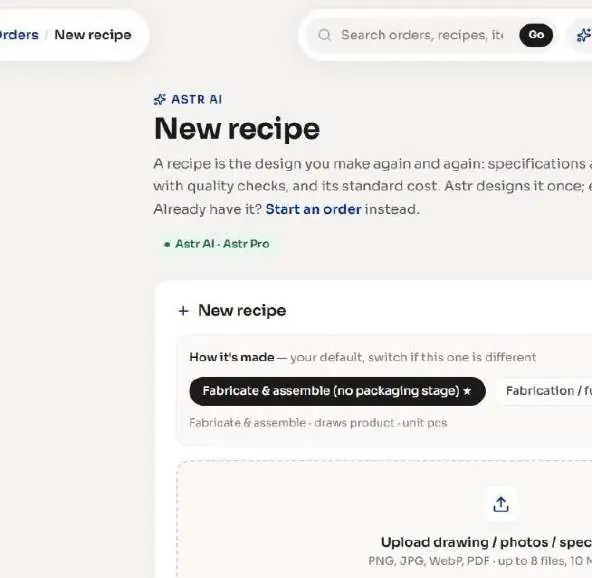
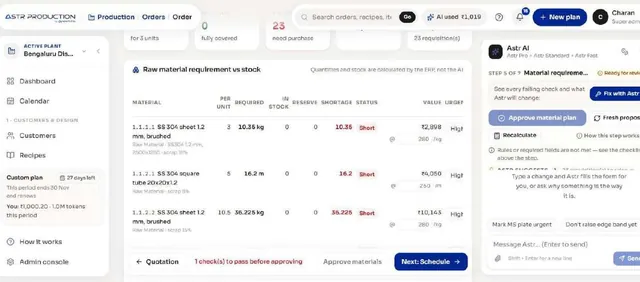
| ASTR Production | Versioned formulations with role-based access, batch steps, deviations |
| Machine Digital Twin | Continuous reactor temperature, pressure and addition-rate profiles |
| Anvaya | Material records with hazard data, compatible storage, lots, customer specs, CoA generation |
| ASTR Reporting | Profile comparison between good and complaint batches |
How it rolled out
- Reactor signal capture on two reactors.
- Formulation migration with approvals.
- Customer spec library.
- CoA automation.
What changed
Variation became explainable by process profiles, and corrective parameters were added to formulations.
- Customer complaints reduced by [X]%.
- CoA preparation time reduced by [X]%.
- Formulation access fully logged.
What we would tell a similar company
- Capture continuous data on critical reactors.
- Control formulation versions properly.
- Keep customer specs next to test results.
- Show hazard information where materials are used.
Frequently asked questions
Can formulations be protected?
Yes, with role-based access and partial views.
Is reactor data hard to capture?
Usually not — it often exists in PLCs or DCS.
Is this a real customer?
It is an illustrative composite.
- #specialty chemicals software case study
- #chemical formulation management case
- #reactor monitoring
- #certificate of analysis automation
- #chemical plant digital
Trikaan Research & Engineering
Trikaan
Written by the researchers and engineers who build Anvaya, ASTR and Seed Track, with input from Trikaan's delivery and engineering teams.