Solution stories
Modular Furniture: Drawings to Dispatch Without Re-Typing
Moving the bottleneck from the estimator’s desk back to the factory with ASTR Drawing, ASTR Production and Anvaya.
 Trikaan Research & Engineering4 min read
KEY TAKEAWAYS
- The bottleneck was the estimator’s desk, not the CNC.
- Drawing-to-BOM automation freed estimators to review instead of type.
- Panel labels connected every part to its order.
- Hardware planning removed the most common dispatch delay.
A manufacturer of modular wardrobes, kitchens and office furniture was growing fast, but every order passed through a small estimating team that re-typed drawings into spreadsheets.
Here is how the bottleneck moved from the office to the factory — where it belonged.
The situation
Orders came from dealers and interior designers as PDF drawings. Estimators produced BOMs, cutting lists and quotes manually. Errors surfaced at assembly: wrong panel sizes, missing hardware, old revisions.
Quotes took days, and margins on complex orders were unclear until after dispatch.
What they had already tried
- Hiring more estimators.
- Standard spreadsheets per product type.
- Cutting software used separately from the BOM process.
How we diagnosed the real problem
We sat with estimators for a week, then followed ten orders from drawing to dispatch.
- Most estimating time went into take-off, not pricing.
- Revisions reached the floor late or not at all.
- Hardware shortages caused more dispatch delays than board shortages.
- Board yield varied widely because orders were cut one at a time.
The solution, product by product
No single product solved this. The value came from the products working on the same data.
| Product | Role in this solution |
|---|---|
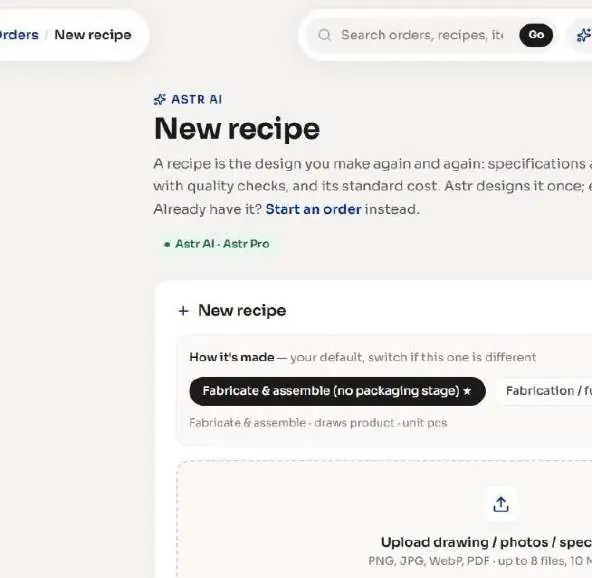
| ASTR Drawing | Read dealer drawings, extract panels, edges and hardware, generate BOM, cutting lists and route cards |
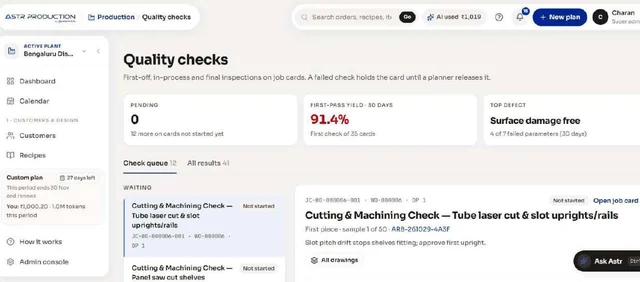
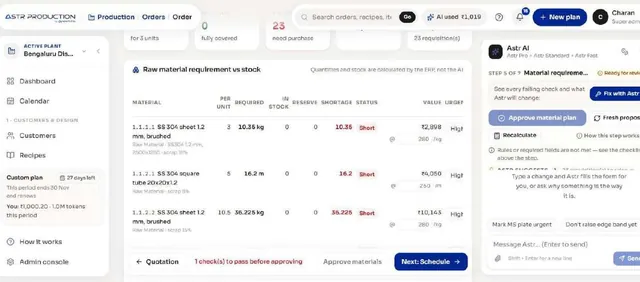
| ASTR Production | Batch orders by material for cutting, job cards per station, costing per order |
| Anvaya | Board and hardware inventory, purchase, dealer orders, dispatch and invoicing |
| ASTR Reporting | Quote turnaround, board yield and margin by dealer and product |
How it rolled out
- Templates for the top product families.
- Drawing reading with estimator review.
- QR panel labels and station scanning.
- Hardware reservation at order release.
What changed
Estimators became reviewers. The shop floor worked from current revisions with labelled parts.
- Quote turnaround reduced from days to [X] hours.
- Board yield improved by [X]% through batched nesting.
- Rework from revision errors reduced by [X]%.
- Margin per order visible before dispatch.
What we would tell a similar company
- Build templates for your top product families first.
- Label every panel.
- Plan hardware with the same care as boards.
- Compare quoted and actual cost on every order.
Frequently asked questions
Can drawings from different dealers be read?
Yes, with review; consistent formats improve results.
Does this require CNC integration?
No, but it adds further gains.
Is this a real customer?
It is an illustrative composite.
- #modular furniture manufacturing case study
- #furniture drawing to BOM
- #panel cutting optimisation case
- #furniture ERP implementation
- #ASTR Drawing furniture
Trikaan Research & Engineering
Trikaan
Written by the researchers and engineers who build Anvaya, ASTR and Seed Track, with input from Trikaan's delivery and engineering teams.