Trikaan
  • Anvaya

    AnvayaConnected business operations - supply chain, sales, finance, HR and more on one platform.

    ASTR AI Suite

    ASTR ProductionProduction intelligence - recipes, smart BOM, costing, planning and quality.Astr AIThe AI layer across every Trikaan product - ask, analyse and automate in plain language.ASTR Drawing & Plan GeneratorTurn customer drawings into BOM, BOQ, cutting lists and production plans.ASTR Reporting AssistantAsk in plain language - get reports in Excel, PDF, CSV or PPT in seconds.Machine Digital TwinLive machine models connected to PLC & SCADA data for OEE and maintenance.

    Agriculture

    Seed TrackField intelligence for seed production - growers, fields, visits, QA and yield.
    Not sure which product fits your business?Book a Demo →
  • Industries

    FurnitureFrom concept to engineering, powered by AI.FMCGFrom product planning to market execution.PharmaceuticalFrom formulation to compliance.AutomotiveFrom component design to vehicle manufacturing.Food & BeverageFrom ingredients to finished products.ConstructionFrom project planning to execution.ChemicalFrom chemical formulation to process optimisation.Agri & SeedFrom grower’s field to sealed seed bag.
    Industry-specific solutions. Powered by ASTR.All industries →
  • Build & Integrate

    Software built around your process

    Workflow Digitisation & OptimisationCustom Application DevelopmentERP & Systems IntegrationMobile & Field ApplicationsData Migration & Legacy Modernisation

    Engineering & Automation

    From drawings to the shop floor

    Drawing-to-Production EngineeringPLC, SCADA & Hardware IntegrationDigital Twin & 3D Plant ModellingPredictive Maintenance & OEEAI Reporting & Analytics

    Operations

    Run the business on connected data

    Procurement & Supply ChainInventory & Warehouse SolutionsProduction Planning & SchedulingQuality & Compliance SystemsCosting & Margin Intelligence

    Industry Services

    Industry-focused services

    Manufacturing SolutionsAgri & Seed SolutionsConstruction & Interior SolutionsImplementation, Training & Support
    Beyond software - we engineer around your business.All services →
  • Engineering

    How We WorkEngineeringData SecurityData PrivacyCloud & Hosting

    Your vision. Our engineering.

    Explore our engineering capabilities →
  • Pricing
  • FAQ
Book a Demo
  • Home
Trikaan

Your Business. Connected Through Intelligence.

Company

Who we areHow we workEngineeringPricingCareersBlogContact

Solutions

Seed TrackAnvayaASTR ProductionASTR DrawingASTR ReportingMachine Digital TwinIndustries

Services

All servicesWorkflow DigitisationSystems IntegrationPLC & SCADACustom EngineeringNetwork Security & VPN

Trust & Legal

Data securityData privacyCloud & hostingPrivacy PolicyTerms of ServiceCookie Policy

© 2026 Trikaan Solutions Pvt. Ltd. All rights reserved.

PrivacyTermsCookies

Enterprise engineering for the way manufacturing actually works.

Multi-plant, multi-entity, multi-currency operations need more than an app. They need research that finds the real constraint, architecture that survives ten years of change, AI you can govern and delivery your board can audit. This page shows exactly how we do each of those.

Request the technical due-diligence pack →Talk to an architect
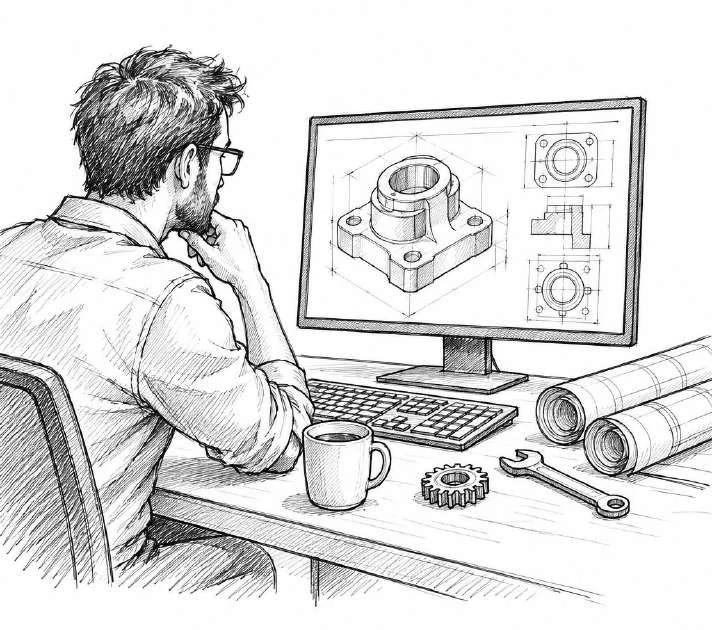
Pencil sketch of an engineer studying a CAD drawing of a machine part
Collective > Individual
  • 01·Problem at scale
  • 02·Research
  • 03·Architecture
  • 04·Integration
  • 05·AI governance
  • 06·Scale & reliability
  • 07·Tech stack
  • 08·New technologies
  • 09·Quality & release
  • 10·Team

01 · The problem at your scale

At Investing Crores and beyond, the problem is no longer “we need software”.

It is a landscape of ERPs, spreadsheets, plant systems and people that grew one decision at a time. We engineer for that landscape — not around it.

Many plants, many truths

Each plant runs its own spreadsheets, codes and habits. Group numbers are stitched together by hand every month.

How we engineer for it: One data model with plant-level configuration, group-level reporting and common masters.

An ERP that stops at the gate

Finance and purchase live in the ERP; the shop floor, quality and maintenance live outside it.

How we engineer for it: Integrate with the ERP as system of record; extend it with production, quality and machine intelligence.

Machines nobody can see

Expensive equipment with PLCs and SCADA, but no live link to planning, cost or maintenance.

How we engineer for it: Read-only OT integration through edge gateways, segmented from your IT network.

People change faster than systems

Supervisors, contractors and shifts rotate; knowledge leaves with them.

How we engineer for it: Role-based apps, local languages and process knowledge captured as recipes and checklists.

Audits, customers and regulators

Every number must be traceable — to a batch, a person and a time.

How we engineer for it: Immutable audit trails, versioned masters and lot genealogy built into the data model.

Growth by acquisition

New entities arrive with their own systems and charts of accounts.

How we engineer for it: Multi-company, multi-currency tenancy and a repeatable onboarding playbook for new sites.

02 · How we understand the problem

Evidence before opinions. Measured before modelled.

Research runs in three tracks at the same time — people, process and data — so the solution is shaped by what actually happens on your floor, not by what the org chart says.

Track · People

Who does the work, and what slows them down?

  • Interviews from CXO to operator
  • Shift shadowing on every critical process
  • Pain-point and workaround log
  • Decision-rights mapping

Output: Personas and stakeholder map

Track · Process

How does work really flow — and where does it break?

  • Gemba walks across the value stream
  • As-is maps with time and hand-offs
  • Loss trees for yield, downtime and cost
  • Exception and rework analysis

Output: As-is maps and loss trees

Track · Data

What do we know, where is it, and can we trust it?

  • System and spreadsheet inventory
  • Data-quality profiling on samples
  • Master-data duplication check
  • Machine signal and tag survey

Output: Data inventory and quality report

Research in practice: “Why is our yield different every month?”

Illustrative walkthrough

  1. Week 1 · Observe

    Walk the line

    Gate to dispatch over three shifts. Weighbridge, lab, process and packing registers photographed.

  2. Week 1 · Ask

    Interview 15 people

    Plant head, shift in-charges, lab, stores and accounts each give a different reason.

  3. Week 2 · Measure

    Join the data

    Weighbridge, moisture, production and dispatch joined for one quarter, batch by batch.

  4. Week 2 · Find

    Locate the loss

    Variance traced to intake moisture recorded after weighing, and to one stage without a yield check.

  5. Week 3 · Propose

    Design the fix

    Moisture at the gate tied to price, stage-wise yield capture and a daily yield report.

You receive:

Client assessment reportAs-is process mapsLoss treesData inventoryStakeholder mapPrioritised opportunity listSuccess measures with baselinesPhased roadmap

03 · How we architect

Architecture that survives acquisitions, new plants and ten years of change.

  • System-of-record clarity

    Each data object has exactly one master — ERP, Anvaya or plant system.

    What it means for you: No duplicate entry, no month-end reconciliation.

  • Multi-entity by design

    Companies, plants, warehouses and currencies modelled from day one.

    What it means for you: Add a plant or acquisition without a re-implementation.

  • API-first

    Every capability exposed through versioned, documented APIs.

    What it means for you: Your IT team can extend and integrate without us.

  • Modular domains

    Supply chain, production, quality, finance and people as separable modules.

    What it means for you: Start small; switch on modules as value is proven.

  • Secure by default

    Least-privilege roles, encryption and audit built in, not configured later.

    What it means for you: Pass security reviews without retrofits.

  • Offline-tolerant edges

    Plant gateways and field apps buffer data when networks drop.

    What it means for you: No data loss on the floor or in the field.

  • Observable

    Metrics, logs and traces for every service.

    What it means for you: Issues found before users report them.

  • Exit-ready

    Open formats, exportable data and documented interfaces.

    What it means for you: You are never locked in.

Reference architectureMulti-plant enterprise
  1. ExperienceRole-based, multi-language
    • Web apps
    • Mobile & offline apps
    • Customer & vendor portals
    • CXO dashboards
  2. Identity & accessYour identity provider
    • Single sign-on
    • Role & plant permissions
    • API gateway
  3. Domain servicesModular, versioned APIs
    • Supply chain
    • Production
    • Quality
    • Maintenance
    • Finance
    • People
  4. IntelligenceHuman-in-the-loop
    • ASTR language models
    • AI agents with approvals
    • Forecasting
    • Vision
  5. IntegrationRetry, monitoring, audit
    • ERP connectors
    • Event bus
    • E-invoicing & statutory
    • File & EDI
  6. DataPer-tenant isolation
    • Transactional store
    • Time-series history
    • Documents & drawings
    • Analytics warehouse
  7. Edge & OTOutbound-only, segmented
    • Edge gateways
    • PLC / SCADA
    • Sensors
    • Weighbridges & scanners

Every major decision is written down. Here’s what one looks like.

Architecture decision record · Example

Context

Field teams work in villages with no network for hours. Visits, maps and onboarding must not wait for connectivity.

Options considered

  • Online-only web app
  • Online app with local cache
  • Offline-first with local database and queued sync

Decision

Offline-first: local database on device, queued sync with conflict review on the portal.

Consequences

More complex sync logic and testing; in return, zero lost visits and verifiable GPS evidence captured at the moment of work.

04 · Integration with what you already run

We don’t ask you to rip out your ERP. We make it smarter.

ERP

Master & transaction sync

Items, vendors, customers and ledgers from your ERP; production, consumption and quality results back to it.

Typical: SAP, Oracle, Microsoft Dynamics, Tally, others [confirm]

Statutory

E-invoicing & e-way bills

Invoices and dispatches flow to statutory portals from the same transaction.

Typical: GST e-invoice, e-way bill [confirm]

Events

Real-time event streams

Order released, batch closed, machine stopped — published as events other systems can subscribe to.

Typical: Webhooks, message queues

Identity

Single sign-on & user provisioning

Users and roles managed in your identity provider.

Typical: SAML / OpenID Connect providers

OT

Machines & plant systems

PLC tags, SCADA alarms, weighbridges and scanners through edge gateways.

Typical: OPC UA, Modbus, MQTT

Data

Analytics & data lake

Curated data feeds into your BI or data platform.

Typical: Scheduled exports, warehouse connectors

Systems we commonly connect to include ERPs, accounting software, CRMs, HR and payroll, e-invoicing and e-way bill portals, weighbridges, PLC/SCADA and identity providers. [Confirm the named systems you have delivered integrations for before publishing.]

05 · AI you can govern

AI that a plant head can trust and an auditor can check.

Every AI feature in ASTR is designed around one rule: AI proposes, people approve, the system records. Here is what that means in engineering terms.

Human approval for actions

Recipes, BOMs, schedules and purchase requests generated by AI wait for a named approver before they take effect.

Grounded answers

Answers are built from your own records and documents, with links back to the source rows.

Role-aware AI

ASTR only reads data the asking user is allowed to see.

Tenant isolation

Your data is never used to train models for other customers.

Evaluation before release

AI features are tested on representative cases from your plant before going live.

Full traceability

Every prompt, answer, approval and edit is logged with user and time.

Confidence & fallbacks

Low-confidence outputs are flagged for review instead of being presented as fact.

Switchable per module

AI can be enabled, limited or turned off by module and role.

AI lifecycle

1. Define use case & metric2. Prepare & permission data3. Evaluate on your cases4. Pilot with approvals5. Monitor quality6. Review & retrain

06 · Scale, performance & reliability

Engineered against targets — agreed with you, measured every release.

DimensionHow we engineer itTarget we agreeHow you see it
AvailabilityRedundant services, health checks, automatic failoverUptime 95% monthlyStatus page and monthly report
Response timeIndexed queries, caching, performance budgets per screenp95 ms for key screensRelease performance report
ConcurrencyStateless services that scale horizontallyN concurrent users per tenantLoad-test results before go-live
Data volumePartitioned history, archiving policiesYears of transactions onlineCapacity review each quarter
Machine dataTime-series storage with downsamplingSignals/sec per plantGateway and ingestion dashboards
RecoveryEncrypted backups, point-in-time restore, DR runbooksRPO · RTOAnnual DR test report
Offline toleranceEdge buffering and mobile queued syncfew hours without networkSync status per device
Change safetyAutomated tests, staged rollout, instant rollbackZero-data-loss releasesRelease notes and change log

08 · Newest technologies, applied

New technology, judged by one question: does it move a plant metric?

TechnologyWhat it does on your floorMetric it movesWhere it runsMaturity
Agentic AI with approvalsAgents draft purchase requests, re-plan schedules after a breakdown and prepare reports — then wait for approval.Planning effort, response timeCloudPilot
Generative drawings & plansFloor plans, layouts and product drawings from a brief, then BOQ and BOM from the drawing.Estimation time, BOM errorsCloudIn production
Vision AI for drawingsDimensions, parts and notes read from PDFs, scans and photos.Take-off timeCloudIn production
Vision AI for qualityDefects detected from line cameras and inspection photos.Defect escape rateEdge + cloudPilot
Predictive maintenance MLSignal trends compared with OEM limits to flag failures days ahead.Unplanned downtime, MTBFEdge + cloudPilot
Live digital twinsPlants modelled in 3D/2D and bound to PLC signals.Visibility, response timeCloudPilot
Natural-language analyticsPlain-language questions become exact reports and files.Report turnaroundCloudIn production
Edge AIModels running on plant gateways for instant, offline decisions.Latency, uptimeEdgeR&D

Maturity: In production = live with customers · Pilot = running with selected customers · R&D = in development. [Confirm each status.]

09 · Quality engineering & release

Every change travels the same road to production.

  1. 01

    Plan

    Story with acceptance criteria

  2. 02

    Build

    Feature branch, peer review

  3. 03

    Test

    Unit, integration, end-to-end

  4. 04

    Scan

    Security and dependencies

  5. 05

    Stage

    Your team tests on staging

  6. 06

    Approve

    Change approval for production

  7. 07

    Release

    Staged rollout, monitoring

  8. 08

    Verify

    Post-release checks, rollback ready

Definition of done

Code, tests, docs and release note — or it isn’t done.

Test automation

Critical business flows covered end to end.

Code review

Every change reviewed by a second engineer.

Environments

Development, staging and production fully separated.

Change log

Every release documented in plain language.

Performance budgets

Key screens measured against agreed targets each release.

Accessibility

Contrast, labels and keyboard support checked.

Knowledge transfer

Architecture, runbooks and admin guides handed over.

10 · The team on your programme

Named people, clear roles, continuity from visit to go-live.

Engagement lead

Single point of accountability for outcomes and commercials.

Throughout

Solution architect

Owns architecture, integration design and decision records.

Discovery → go-live

Business analyst

Process maps, requirements and acceptance criteria.

Discovery → UAT

Product designer

Research, prototypes and usability testing.

Design → build

Engineering team

Full-stack, mobile, data and AI engineers.

Build → hypercare

OT / IoT engineer

Machine connectivity, gateways and tag mapping.

Survey → go-live

QA engineer

Test strategy, automation and UAT support.

Build → release

Implementation & support

Training, migration, floor support and help desk.

Go-live → ongoing

Technical due-diligence pack

Everything your IT and procurement teams will ask for — in one pack.

Shared under NDA within [X] business days of request.

Request the pack →
  • Solution architecture

    Logical and deployment diagrams

  • Security questionnaire

    Pre-filled standard responses

  • Data flow & residency

    What flows where, and where it is stored

  • Integration catalogue

    APIs, connectors and event specs

  • Non-functional targets

    Availability, performance, recovery

  • AI governance note

    Controls, logging, data use

  • DR & backup plan

    RPO, RTO and test approach

  • Sample SOW & SLA

    Scope, milestones and service levels

  • Data processing agreement

    Roles, sub-processors, obligations

  • Exit & portability plan

    Data export and handover
Questions CTOs ask us

Will this replace our ERP?

No. Your ERP stays the system of record for finance and masters. We integrate with it and extend it to the shop floor — production, quality, maintenance and machine data — so nothing is ripped out.

Who owns the code and the data?

Your data is always yours, in open, exportable formats. Ownership of custom code and configuration is set out in the SOW, and architecture, interfaces and runbooks are documented and handed over.

Can our internal IT team take over?

Yes. The platform is API-first with documented interfaces, decision records and admin guides. Knowledge transfer is part of every engagement, and your team can extend and integrate without us.

How do you handle multiple plants with different processes?

One data model with plant-level configuration: each plant keeps its own routings, recipes and approvals, while masters and group reporting stay common. New plants follow a repeatable onboarding playbook.

Can we host it ourselves?

Yes. Run it in Trikaan cloud, a dedicated environment, your own cloud account, on-premise or hybrid with plant edge gateways — operated to the same standard. See Cloud & Hosting for the comparison.

How do you stop AI from making things up?

Answers are grounded in your own records with links to the source rows, low-confidence outputs are flagged for review, and any action AI proposes waits for a named approver. Every prompt and approval is logged.

What does a typical enterprise rollout look like?

An assessment of one plant, a pilot on one plant or value stream with measured results, then a wave-based rollout across plants under a programme office with agreed SLAs.

How do you protect our plant network?

OT integration is read-only through edge gateways that make outbound-only connections, segmented from your IT network. There is no write path from the cloud to your controllers.

procurement
ASTR AI
quality
engineer
Seed Track
Anvaya
operator
finance
planner

Your Vision. Our Engineering.

Book a Demo

Powered by AI. Engineered by Trikaan.