Industry playbooks
Managing Thousands of Seed Growers Without Losing Control
Seed programmes depend on growers you rarely see. The data, routines and tools that keep quality and isolation under control.
 Trikaan Research & Engineering4 min read
KEY TAKEAWAYS
- Seed quality is decided in fields you rarely see.
- Register growers and fields precisely, with mapped boundaries.
- Plan inspections around crop stages, not calendars.
- Link field data to seed lots for full traceability.
A seed company’s product starts in hundreds or thousands of fields owned by contracted growers. Genetic purity, isolation, timely roguing and harvest discipline all happen far from head office.
This article covers the routines and data that keep seed production under control.
Grower and field registration
- Grower identity, contact and consent.
- Field location with mapped boundary and calculated area.
- Variety, parent lines and sowing dates.
- Neighbouring crops relevant to isolation.
Isolation and purity
Isolation requirements depend on crop and class of seed. Mapping fields and neighbouring crops makes risks visible early. Officers can flag nearby plantings with photos and location during visits, and agronomists can decide on action before flowering.
Stage-based inspections
| Stage | Typical focus |
|---|---|
| Sowing | Correct seed, ratio, planting pattern |
| Vegetative | Plant stand, off-types, pests |
| Flowering | Isolation, roguing, detasselling where relevant |
| Maturity | Yield estimate, harvest timing |
| Harvest | Quantity, moisture, lot creation |
From field to seed lot
Harvested produce becomes seed lots at the processing plant. Linking each lot to its fields, inspections and growers means a quality issue found in testing can be traced back to its source — and growers can be paid accurately for quality.
Grower relationships
Growers are partners, not suppliers on a list. Timely advice, fair quality assessment and prompt payment keep good growers in the programme year after year. A complete record of each grower’s history — fields, yields, quality, payments — helps officers give better advice and lets the company recognise reliable growers.
Clear communication about how grower data is used, and consent captured properly, builds the trust that long programmes depend on.
Season review
- Yield and quality by variety, region and grower.
- Inspection coverage and timeliness.
- Isolation incidents and outcomes.
- Officer workload and visit patterns.
- Payment timeliness.
Managing by exception
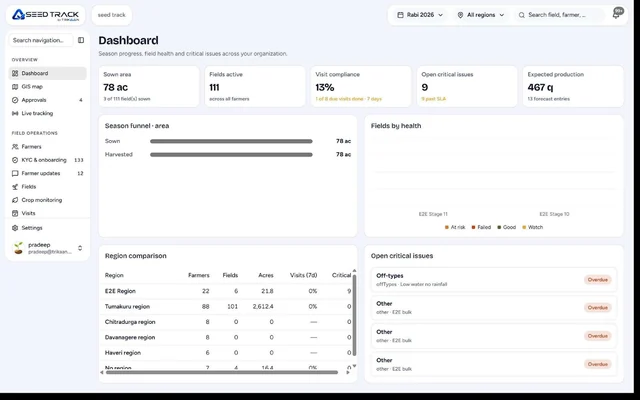
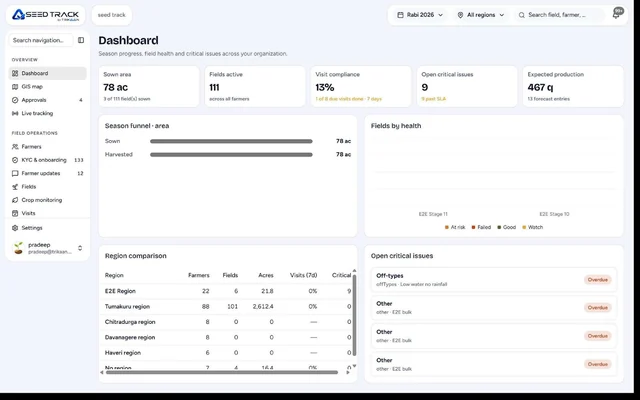
With visits and crop stages in one system, managers can focus on fields behind expected stage, overdue inspections and isolation risks, rather than reading every report.
Frequently asked questions
How do seed companies track growers?
Through grower registration, mapped fields, scheduled visits and inspection records, ideally in an offline-capable app.
What is isolation distance?
The minimum separation from other crops of the same species needed to protect genetic purity; it varies by crop and seed class.
Can field data link to seed lots?
Yes — harvest records create the link between fields and lots at processing.
Do growers need to use the app?
Usually field officers use it; growers are registered and informed through officers.
- #seed production management
- #seed grower management
- #contract farming software
- #seed certification inspection
- #isolation distance
Trikaan Research & Engineering
Trikaan
Written by the researchers and engineers who build Anvaya, ASTR and Seed Track, with input from Trikaan's delivery and engineering teams.